
Articulation & Language Norms
For those of you who thought our norms never truly matched how "typical" children developed speech, you were right!
If you ever worked with children earlier than the magical age of "8" for /r/ and had more success, did you ever wonder if it was because we were waiting too long to intervene?
Why did it seem we were holding children with articulation delays to a HIGHER standard than those without delays?
Because we were!
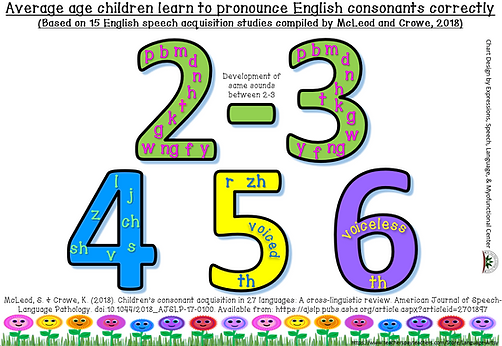
Average age children learn to pronounce English consonants correctly
(Based on 15 English speech acquisition studies compiled by McLeod and Crowe, 2018)


Sourced: McLeod, S. & Crowe, K. (2018). Children’s consonant acquisition in 27 languages: A cross-linguistic review. American Journal of Speech-Language Pathology. doi:10.1044/2018_AJSLP-17-0100. Available from: https://ajslp.pubs.asha.org/article.aspx?articleid=2701897


Language Milestones
Click the images to expand or download!


CLICK HERE to view or download.
One of the most amazing collection of norms for intelligibility, pronouns, grammar, etc.----- Linguisystems Milestone Guide

Neurological and Developmental Foundations of Speech Acquisition
Sourced: McLeod, S., & Bleile, K. (2003, November). Neurological and developmental foundations of speech acquisition. In American Speech-Language-Hearing Assoc. Convention, Chicago.


LEFT SIDE OF BAR: This is where 50% of children are producing this sound, not 0%. In other words the bar is not a developmental progression since it starts at 50%.
RIGHT SIDE OF BAR: This is where 90% of children are producing this sound. This means that by waiting until 8 to target /r/, we are two years beyond the point where 90% of children are producing this sound.
Is there any wonder why /r/ is so hard to correct?
Are we waiting too long to intervene?